Across the United States, discussions about global tensions sometimes raise questions about what could happen in an extreme scenario involving nuclear conflict. While there is currently no global war underway, defense analysts and researchers regularly conduct simulations to understand how geography, weather patterns, and military infrastructure might influence outcomes in worst-case situations. These studies are not predictions but planning tools designed to help policymakers and emergency officials prepare for potential risks.
One key factor often examined in these simulations is the location of strategic military assets, particularly intercontinental ballistic missile (ICBM) silos. These installations are part of the United States’ nuclear deterrence system and are primarily located in five states: Montana, North Dakota, Wyoming, Nebraska, and Colorado. Because these facilities are fixed and publicly known, they are frequently included in theoretical modeling as possible targets in a large-scale conflict scenario.
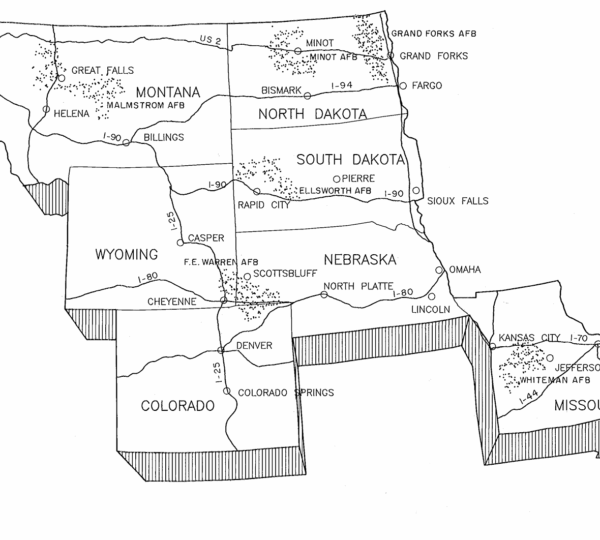
Research from institutions such as Princeton University and other scientific organizations has also explored how radioactive fallout might spread if such sites were attacked. These models use historical wind patterns and atmospheric simulations to estimate how radiation could move across different regions. Some studies suggest that nearby states in the Great Plains and parts of the Midwest could experience higher levels of fallout depending on weather conditions at the time.
At the same time, modeling sometimes shows parts of the East Coast, Southeast, and certain western states experiencing comparatively lower levels of direct radiation exposure due to their distance from silo fields. However, experts emphasize that “lower risk” does not mean “no risk.” In any large-scale nuclear exchange, the impact would extend far beyond initial target areas through environmental damage, infrastructure disruption, and economic consequences.
Ultimately, researchers stress that these simulations exist to support preparedness and resilience, not to create fear. Governments, scientists, and international organizations continue to focus on diplomacy, deterrence, and emergency planning to prevent nuclear conflict altogether. The goal of these studies is to better understand potential vulnerabilities and ensure that communities are prepared for a wide range of large-scale emergencies.